
Comparative Effects of Topically Applied Tocotrienol (T3) Isomers in Promoting Cutaneous Wound Healing in Obese Type 2 Diabetes Mice
Tocotrienols in Diabetic Wound Healing
Vol. 21 No. 2 : 2026 (1034-1055)

Abstract
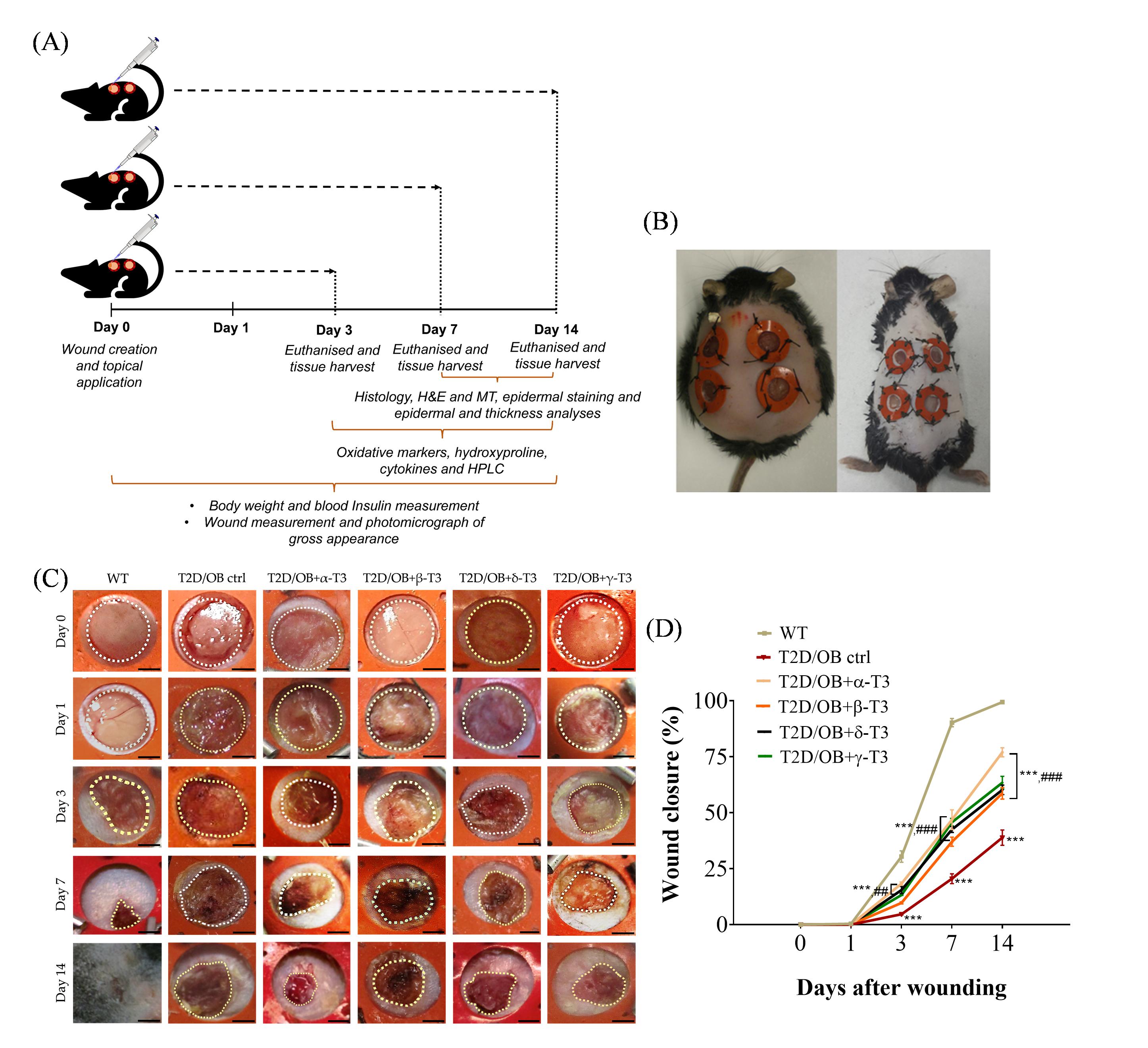
Diabetic foot ulcers are a significant complication, especially for type 2 diabetes and obese patients. This is mainly caused by an excessive and persistent inflammatory-oxidative stress environment in the wounds, which impedes healing. Tocotrienol, a phytochemical with antioxidant and anti-inflammatory properties, holds notable therapeutic potential. Therefore, this study aimed to investigate the healing effects of topically applied tocotrienol isomers (α-, β-, δ- and γ-T3) on full-thickness excisional cutaneous wounds in male B6.V-Lepob/JRj mice. Treatment effects were evaluated through wound closure rate, histopathology, collagen deposition, hydroxyproline content and the levels of superoxide dismutase, catalase, glutathione peroxidase, glutathione, malondialdehyde and myeloperoxidase in the wound granulation tissues. Cytokine, chemokine, and growth factor levels were quantified using the Luminex assay. The presence of isomers in wound granulation tissue was determined by high-performance liquid chromatography. Results showed that T3 isomers facilitated tissue regeneration and hastened wound closure. They significantly reduced oxidative stress by lowering malondialdehyde and myeloperoxidase levels and by enhancing antioxidant activity and production. These isomers effectively diminished pro-inflammatory cytokines and chemokines, while increasing anti-inflammatory cytokines and modulating growth factors, thereby promoting wound healing in B6.V-Lepob/JRj mice. These findings suggest that T3 isomers may serve as therapeutic agents that enhance cutaneous wound healing in individuals with diabetes.
Keywords :
Anti-inflammatory; antioxidant; skin wound healing; tocotrienol; topical treatment; type 2 diabetic mice,
Correspondance Address
suzanamakpol@hctm.ukm.edu.my (SM); zaizuhana@mpob.gov.my (ZS)
References
Abdo, A.I., Nguyen, H.T., Kaul, L.D., Schmitt-John, T., Kopecki, Z., Ogunniyi, A.D., Richter, K. 2025. Plasma-activated water accelerates wound healing and reduces Staphylococcus aureus infection in vivo. Biofilm 10: 100308. https://doi.org/10.1016/j.bioflm.2025.100308
Abdul Jalil, N.A., Ahmad, F., Sankar, D., Hasnol, M.F., Azahari, N.A., Syed Shahrin, S.A., Wong, Z. 2024. Effect of caffeic acid phenethyl ester on wound healing: A systematic review. Med Health 19(1): 25-39. https://doi.org/10.17576/MH.2024.1901.02
Ahmad, S.U., Akter, S., Ghose, K.K., Tahira, R.N., Nasreen, W., Bhuiyan, M.A. 2025. Evaluation of wound healing, antioxidant and antimicrobial effects of Cinnamomum zeylanicum extracts: In vivo and in vitro approaches. Med Health 20(2): 546-61. https://doi.org/10.17576/MH.2025.2002.08
Alexeev, V., Huitema, L., Phillips, T., Patel, P., Garza, M.S., Ringpfeil, F., Salas-Alanis, J.C., Igoucheva, O. 2025. Cross-sectional analysis of wound-associated soluble factors in early, established, and chronic wounds of recessive dystrophic epidermolysis bullosa patients. Arch Dermatol Res 317(1): 796. https://doi.org/10.1007/s00403-025-04293-w
Alfaris, S., Almazyad, A., Omari, J., Gao, Y., Balasubbramanian, D., Bielenberg, D.R. 2022. Deletion of neuropilin-1 in the epidermis delays wound healing. FASEB J 36(S1): e22187. https://doi.org/10.1096/fasebj.2022.36.S1.R5980
Ali, H., El-Sayed, K., Sylvester, P.W., Nazzal, S. 2010. Molecular interaction and localization of tocotrienol-rich fraction (TRF) within the matrices of lipid nanoparticles: Evidence studies by differential scanning calorimetry (DSC) and proton nuclear magnetic resonance spectroscopy (1H NMR). Colloids Surf B Biointerfaces 77(2): 286-97. https://doi.org/10.1016/j.colsurfb.2010.02.003
Ali, M.S., Pebam, M., Buddhiraju, H.S., Dey, S., Bantal, V., Ganapathy, N., Madhavan, D., Rengan, A.K. 2024. Accelerating diabetic wound healing by modulating the inflammatory environment using quercetin-rosemary oil lipid nanoemulsions with artificial intelligence-based wound closure analysis. Adv Ther 7: 2300345. https://doi.org/10.1002/adtp.202300345
Alqahtani, S., Alayoubi, A., Nazzal, S., Sylvester, P.W., Kaddoumi, A. 2013. Nonlinear absorption kinetics of self-emulsifying drug delivery systems (SEDDS) containing tocotrienols as lipophilic molecules: In vivo and in vitro studies. AAPS J 15(3): 684-95. https://doi.org/10.1208/s12248-013-9481-7
Ain, N.J., Diyana, A.S., Hazirah, N.R., Fathiah, N.A., Fairus, A., Teoh, S.L., Anum, Y.M. 2018. The effect of Piper betle on wound healing in male Sprague Dawley rats. Med Health 13(1): 165-74. https://doi.org/10.17576/MH.2018.1301.16
Baldeon-Gutierrez, R., Ohkura, N., Yoshiba, N., Takahara, S., Gomez-Kasimoto, S., Ida, T., Edanami, N., Yoshiba, K., Takenaka, S., Noiri, Y. 2025. Hyperglycemia in obese type 2 diabetes mellitus rats affects pulp wound healing. J Oral Biosci 67(4): 100683. https://doi.org/10.1016/j.job.2025.100683
Bhatti, J.S., Sehrawat, A., Mishra, J., Sidhu, I.S., Navik, U., Khullar, N. 2022. Oxidative stress in the pathophysiology of type 2 diabetes and related complications: Current therapeutic strategies and future perspectives. Free Radic Biol Med 184: 114-34. https://doi.org/10.1016/j.freeradbiomed.2022.03.019
Bitar, M.S. 2019. Diabetes impairs angiogenesis and induces endothelial cell senescence by upregulating thrombospondin-CD47-dependent signalling. Int J Mol Sci 20(3): 673. https://doi.org/10.3390/ijms20030673
Boraldi, F., Lofaro, F.D., Bonacorsi, S., Mazzilli, A., Garcia-Fernandez, M., Quaglino, D. 2024. The role of fibroblasts in skin homeostasis and repair. Biomedicines 12(7): 1586. https://doi.org/10.3390/biomedicines12071586
Callejas, B.E., Sousa, J.A., Flannigan, K.L., Wang, A., Higgins, E., Herik, A.I., Li, S., Rajeev, S., Rosentreter, R., Panaccione, R., McKay, D.M. 2025. Calcitonin gene-related peptide promotes epithelial reparative and anticolitic functions of IL-4 educated human macrophages. Am J Physiol Gastrointest Liver Physiol 328(1): G1-G16. https://doi.org/10.1152/ajpgi.00159.2024
Cai, G., Li, R., Chai, X., Cai, K., Zheng, K., Wang, Y., Fan, K., Guo, Z., Guo, J., Jiang, W. 2024. Catalase-templated nanozyme-loaded microneedles integrated with polymyxin B for immunoregulation and antibacterial activity in diabetic wounds. J Colloid Interface Sci 667: 529-42. https://doi.org/10.1016/j.jcis.2024.04.121
Chang, T.T., Li, Y.Z., Mo, H.W., Chen, C., Lin, L.Y., Chang, C.C., Chen, J.W. 2024. Inhibition of CCL7 improves endothelial dysfunction and vasculopathy in mouse models of diabetes mellitus. Sci Transl Med 16(763): eabo1507. https://doi.org/10.1126/scitranslmed.adn1507
Chen, L., Li, Y., Zhang, X., Ma, L., Zhang, C., Chen, H. 2025. A one-two punch of inflammation and oxidative stress promotes revascularization for diabetic foot ulcers. Mater Today Bio 31: 101548. https://doi.org/10.1016/j.mtbio.2025.101548
Chen, Z., Haus, J.M., DiPietro, L.A., Koh, T.J., Minshall, R.D. 2023. Neutralization of excessive CCL28 improves wound healing in diabetic mice. Front Pharmacol 14: 1087924. https://doi.org/10.3389/fphar.2023.1087924
Chen, Z., Haus, J.M., Chen, L., Jiang, Y., Sverdlov, M., DiPietro, L.A., Xiong, N., Wu, S.C., Koh, T.J., Minshall, R.D. 2022. Inhibition of CCL28/CCR10-mediated eNOS downregulation improves skin wound healing in the obesity-induced mouse model of type 2 diabetes. Diabetes 71(10): 2166-80. https://doi.org/10.2337/db21-1108
Choi, J., Ban, M.J., Gil, C.H., Hur, S.S., Anggradita, L.D., Kim, M.K., Son, J.W., Kim, J.E., Hwang, Y. 2025. Multispectral pulsed photobiomodulation enhances diabetic wound healing via focal adhesion-mediated cell migration and extracellular matrix remodeling. Int J Mol Sci 26(13): 6232. https://doi.org/10.3390/ijms26136232
Chong, W.T., Tan, C.P., Cheah, Y.K., Lai, O.M. 2022. In vitro and in vivo evaluations of tocotrienol-rich nanoemulsified system on skin wound healing. PLoS One 17(5): e0267381. https://doi.org/10.1371/journal.pone.0267381
Ciucanu, C.I., Rațiu, S., Crîșmariu, G.E. 2024. Accelerated wound healing and reduced scar formation induced by D-mannose: A possible role of mannose binding lectin. Arch Dermatol Res 316(8): 600. https://doi.org/10.1007/s00403-024-03338-w
Cohen, J. 2013. Statistical power analysis for the behavioral sciences. New York (NY): Routledge.
Da Silva, J., Figueiredo, A., Tseng, Y.H., Carvalho, E., Leal, E.C. 2025. Bone morphogenetic protein 7 improves wound healing in diabetes by decreasing inflammation and promoting M2 macrophage polarization. Int J Mol Sci 26(5): 2036. https://doi.org/10.3390/ijms26052036
Dasari, N., Jiang, A., Skochdopole, A., Chung, J., Reece, E.M., Vorstenbosch, J., Winocour, S. 2021. Updates in diabetic wound healing, inflammation, and scarring. Semin Plast Surg 35: 153-8. https://doi.org/10.1055/s-0041-1731460
Dawi, J., Tumanyan, K., Tomas, K., Misakyan, Y., Gargaloyan, A., Gonzalez, E., Venketaraman, V. 2025. Diabetic foot ulcers: Pathophysiology, immune dysregulation, and emerging therapeutic strategies. Biomedicines 13(5): 1076. https://doi.org/10.3390/biomedicines13051076
Deng, L., Du, C., Song, P., Chen, T., Rui, S., Armstrong, D.G., Deng, W. 2021. The role of oxidative stress and antioxidants in diabetic wound healing. Oxid Med Cell Longev 2021: 8852759. https://doi.org/10.1155/2021/8852759
Elsy, B., Khan, A.A., Maheshwari, V. 2017. Therapeutic potential of D-δ-tocotrienol-rich fraction on excisional skin wounds in diabetic rats. Our Dermatol Online 8(4): 371-6. https://doi.org/10.7241/ourd.20174.109
Farooq, M., Khan, A.W., Kim, M.S., Choi, S. 2021. The role of fibroblast growth factor (FGF) signalling in tissue repair and regeneration. Cells 10(11): 3242. https://doi.org/10.3390/cells10113242
Gao, S., He, X., Liu, H., Liu, Y., Wang, H., Zhou, Z., Chen, L., Ji, X., Yang, R., Xie, J. 2025. Multifunctional bioactive nanozyme systems for enhanced diabetic wound healing. Adv Healthc Mater 14(8): e2401580. https://doi.org/10.1002/adhm.202401580
Gomes, A., Leal, E.C., Da Silva, J., Teixeira, I., Ferraz, R., Calheiros, D., Gomes, P. 2025. Enhancement of wound healing in diabetic mice by topical use of a peptide-ionic liquid conjugate. Int J Biochem Cell Biol 180: 106753. https://doi.org/10.1016/j.biocel.2025.106753
González, P., Lozano, P., Ros, G., Solano, F. 2023. Hyperglycemia and oxidative stress: An integral, updated and critical overview of their metabolic interconnections. Int J Mol Sci 24(11): 9352. https://doi.org/10.3390/ijms24119352
Gostoli, S., Raimondi, G., Popa, A.P., Giovannini, M., Benasi, G., Rafanelli, C. 2024. Behavioral lifestyle interventions for weight loss in overweight or obese patients with type 2 diabetes: A systematic review of the literature. Curr Obes Rep 13(2): 224-41. https://doi.org/10.1007/s13679-024-00552-5
Guo, H.F., Hamid, R.A., Ali, R.M., Chang, S.K., Rahman, M.H., Zainal, Z. 2020. Healing properties of epidermal growth factor and tocotrienol-rich fraction in deep partial thickness experimental burn wounds. Antioxidants 9(2): 130. https://doi.org/10.3390/antiox9020130
Guo, H.F., Mohd Ali, R., Abd Hamid, R., Chang, S.K., Rahman, M.H., Zainal, Z., Khaza’ai, H. 2022. Epidermal growth factor and tocotrienol-rich fraction cream formulation accelerates burn healing process based on its gene expression pattern in deep partial thickness burn wound model. Int J Low Extrem Wounds 21(4): 544-54. https://doi.org/10.1177/1534734620971066
Han, R., Chen, M., Peng, W. 2025. Transcutaneous electrical acustimulation promotes wound healing in mice by modulating signalling molecules and mitochondria function. Arch Dermatol Res 317: 368. https://doi.org/10.1007/s00403-024-03754-y
Hassanshahi, A., Moradzad, M., Ghalamkari, S., Fadaei, M., Cowin, A.J., Hassanshahi, M. 2022. Macrophage-mediated inflammation in skin wound healing. Cells 11(9): 2953. https://doi.org/10.3390/cells11192953
He, X., Wang, D., Yi, Y., Tan, Y., Wu, M., Wang, H., Hu, W., Chen, H., Zhang, Q., Wu, Y. 2023. δ-Tocotrienol preconditioning improves the capability of bone marrow-derived mesenchymal stem cells in promoting wound healing by inhibiting BACH1-related ferroptosis. Cell Death Discov 9(1): 349. https://doi.org/10.1038/s41420-023-01653-1
Hegazi, S., Aly, R., Mesilhy, R., Aljohary, H. 2024. Diabetic foot ulcer wound healing and tissue regeneration: Signalling pathways and mechanisms. In: Diabetic Foot Ulcers: Pathogenesis, Innovative Treatments and AI Applications. IntechOpen. https://doi.org/10.5772/intechopen.1004267
Huang, R., Lin, B., Lei, Z., Xu, L., Zhang, H., Wang, W., Zhang, Y., Xiao, S., Long, Y., Li, J., Li, X. 2023. On-site construction of a full-thickness skin equivalent with endothelial tube networks via multilayer electrospinning for wound coverage. ACS Biomater Sci Eng 9(11): 6241-55. https://doi.org/10.1021/acsbiomaterials.3c00913
Ibrahim, N.I., Mohamed, N., Soelaiman, I.N., Shuid, A.N. 2015. The effects of targeted deliveries of lovastatin and tocotrienol on ossification-related gene expressions in fracture healing in an osteoporosis rat model. Int J Environ Res Public Health 12(10): 12958-76. https://doi.org/10.3390/ijerph121012958
Ibrahim, I., Nuermaimaiti, Y., Maimaituxun, G., Luo, X., Maimaituxun, M., Akbar, A., Tuerxun, K., Wu, Y. 2024. Neutrophil extracellular traps (NETs) are associated with type 2 diabetes and diabetic foot ulcer-related amputation: A prospective cohort study. Diabetes Ther 15: 1333-48. https://doi.org/10.1007/s13300-024-01579-6
Ji, X., Yao, H., Meister, M., Gardenhire, D.S., Mo, H. 2021. Tocotrienols: Dietary supplements for chronic obstructive pulmonary disease. Antioxidants 10(6): 883. https://doi.org/10.3390/antiox10060883
Khandaker, M., Alkadhem, N., Progri, H., Nikfarjam, S., Jeon, J., Kotturi, H., Vaughan, M.B. 2022. Glutathione immobilized polycaprolactone nanofiber mesh as a dermal drug delivery mechanism for wound healing in a diabetic patient. Processes 10: 512. https://doi.org/10.3390/pr10030512
Kibibi, M. 2024. Exploration of management strategies for type 2 diabetes among wounded patients: A review. IDOSR J Appl Sci 9: 48-52. https://doi.org/10.59298/IDOSRJAS/2024/9.3.4852000
Kitanaka, N., Nakano, R., Sakai, M., Kitanaka, T., Namba, S., Konno, T., Nakayama, T., Sugiya, H. 2019. ERK1/ATF-2 signalling axis contributes to interleukin-1β-induced MMP-3 expression in dermal fibroblasts. PLoS One 14: e0222869. https://doi.org/10.1371/journal.pone.0222869
Kulkarni, S., Singh, P.K., Ghosh, S.P., Posarac, A., Singh, V.K. 2013. Granulocyte colony stimulating factor antibody abrogates radioprotective efficacy of gamma-tocotrienol, a promising radiation countermeasure. Cytokine 62(2): 278-85. https://doi.org/10.1016/j.cyto.2013.03.009
Lacina, L., Kolář, M., Pfeiferová, L., Gal, P., Smetana, K. Jr. 2024. Wound healing: Insights into autoimmunity, ageing, and cancer ecosystems through inflammation and IL-6 modulation. Front Immunol 15: 1403570. https://doi.org/10.3389/fimmu.2024.1403570
Lakens, D. 2013. Calculating and reporting effect sizes to facilitate cumulative science: A practical primer for t-tests and ANOVAs. Front Psychol 4: 863. https://doi.org/10.3389/fpsyg.2013.00863
Landén, N.X., Li, D., Ståhle, M. 2016. Transition from inflammation to proliferation: A critical step during wound healing. Cell Mol Life Sci 73: 3861-85. https://doi.org/10.1007/s00018-016-2268-0
Liao, T., Lehmann, J., Sternstein, S., Yay, A., Zhang, G., Matthießen, A.E., Schumann, S., Siemers, F., Kruse, C., Hundt, J.E., Langan, E.A., Tiede, S., Paus, R. 2019. Nestin+ progenitor cells isolated from adult human sweat gland stroma promote reepithelialisation and may stimulate angiogenesis in wounded human skin ex vivo. Arch Dermatol Res 311(4): 325-30. https://doi.org/10.1007/s00403-019-01889-x
Lin, X., Wang, H., Li, X. 2021. Mobilization of endothelial progenitor cells promotes angiogenesis after full thickness excision by AMD3100 combined with G-CSF in diabetic mice by SDF-1/CXCR4 axis. Diab Vasc Dis Res 18(2): 14791641211002473. https://doi.org/10.1177/14791641211002473
Mahjabeen, W., Khan, D.A., Mirza, S.A., Pervez, M.A. 2021. Effects of delta-tocotrienol supplementation on glycemic control, oxidative stress, inflammatory biomarkers and miRNA expression in type 2 diabetes mellitus: A randomized controlled trial. Phytother Res 35(7): 3968-76. https://doi.org/10.1002/ptr.7113
Makpol, S., Azura Jam, F., Anum Mohd Yusof, Y., Zurinah Wan Ngah, W. 2011. Modulation of collagen synthesis and its gene expression in human skin fibroblasts by tocotrienol-rich fraction. Arch Med Sci 7(5): 889-95. https://doi.org/10.5114/aoms.2011.25567
Manoj, H., Gomes, S.M., Thimmappa, P.Y., Nagareddy, P.R., Jamora, C., Joshi, M.B. 2024. Cytokine signalling in formation of neutrophil extracellular traps: Implications for health and diseases. Cytokine Growth Factor Rev 76: 101015. https://doi.org/10.1016/j.cytogfr.2024.12.001
Medina-Lombardero, S., Bain, C., Charlton, L., Pellicoro, A., Rocliffe, H., Cash, J., Crichton, M.L. 2024. The biomechanics of wounds at physiologically relevant levels: Understanding skin’s stress-shielding effect for the quantitative assessment of healing. Mater Today Bio 25: 100963. https://doi.org/10.1016/j.mtbio.2024.100963
Medvedev, O.S., Medvedeva, N.A. 2018. Biological properties of tocotrienols. Vopr Pitan 87(2): 5-16. https://doi.org/10.24411/0042-8833-2018-1001
Memarpour, S., Raoufinia, R., Saburi, E., Razavi, M.S., Attaran, M., Fakoor, F. 2024. The future of diabetic wound healing: Unveiling the potential of mesenchymal stem cell and exosomes therapy. Am J Stem Cells 13(2): 87. https://doi.org/10.62347/OVBK9820
Miller, A.W., Anderson, A.R., Suarez-Arnedo, A., Segura, T. 2025. Wound healing splinting devices for faster access and use. JID Innov 5: 100332. https://doi.org/10.1016/j.xjidi.2024.100332
Morgan, N.R., Magalingam, K.B., Radhakrishnan, A.K., Arumugam, M., Jamil, A., Bhuvanendran, S. 2024. Explicating the multifunctional roles of tocotrienol and squalene in promoting skin health. Skin Health Dis 4(5): e448. https://doi.org/10.1002/ski2.448
Muse, M.E., Shumway, K.R., Crane, J.S. 2023. Physiology, epithelialization. In: StatPearls. StatPearls Publishing. https://www.ncbi.nlm.nih.gov/books/NBK532977/ [Accessed on 20 July 2024]
Nair, A.B., Gorain, B., Pandey, M., Jacob, S., Shinu, P., Aldhubiab, B., Almuqbil, R.M., Elsewedy, H.S., Morsy, M.A. 2022. Tocotrienol in the treatment of topical wounds: Recent updates. Pharmaceutics 14(11): 2479. https://doi.org/10.3390/pharmaceutics14112479
Oh, Y.S., Shin, S., Li, H.Y., Park, E.Y., Lee, S.M., Choi, C.S., Lim, Y., Jung, H.S., Jun, H.S. 2015. Betacellulin ameliorates hyperglycemia in obese diabetic db/db mice. J Mol Med 93(11): 1235-45. https://doi.org/10.1007/s00109-015-1303-1
Pan, X., Kaminga, A.C., Wen, S.W., Liu, A. 2021. Chemokines in prediabetes and type 2 diabetes: A meta-analysis. Front Immunol 12: 622438. https://doi.org/10.3389/fimmu.2021.622438
Pierpaoli, E., Orlando, F., Cirioni, O., Simonetti, O., Giacometti, A., Provinciali, M. 2017. Supplementation with tocotrienols from Bixa orellana improves the in vivo efficacy of daptomycin against methicillin-resistant Staphylococcus aureus in a mouse model of infected wound. Phytomedicine 36: 50-3. https://doi.org/10.1016/j.phymed.2017.09.011
Qureshi, A.A. 2022. Tocotrienols: Exciting biological and pharmacological properties of tocotrienols and naturally occurring compounds, part II. Adv Healthc Mater 12: 2301280.
Ramachandran, A., Snehalatha, C., Shetty, A.S., Nanditha, A. 2022. Trends in prevalence of diabetes in Asian countries. World J Diabetes 3(6): 110-7. https://doi.org/10.4239/wjd.v3.i6.110
Rasouli, H., Ramalho, T.C., Popović-Djordjević, J.B., Devkota, H.P. 2023. New opportunities in drug design for the management and treatment of type 2 diabetes. Front Pharmacol 14: 1187057. https://doi.org/10.3389/fphar.2023.1187057
Razali, R.A., Ngah, W.Z.W., Makpol, S., Yanagisawa, D., Kato, T., Tooyama, I. 2025. Shifting perspectives on the role of tocotrienol vs. tocopherol in brain health: A scoping review. Int J Mol Sci 26(13): 6339. https://doi.org/10.3390/ijms26136339
Saeed, S., Martins-Green, M. 2024. Assessing animal models to study impaired and chronic wounds. Int J Mol Sci 25(7): 3837. https://doi.org/10.3390/ijms25073837
Salem, M., Ateya, A., Shouman, Z., Salama, B., Hamed, B., Batiha, G., Ataya, F., Alexiou, A., Papadakis, M., Abass, M. 2024. Amelioration of full-thickness cutaneous wound healing using stem cell exosome and zinc oxide nanoparticles in rats. Heliyon 10(21): e38994. https://doi.org/10.1016/j.heliyon.2024.e38994
Safoine, M., Paquette, C., Gingras, G.M., Fradette, J. 2024. Improving cutaneous wound healing in diabetic mice using naturally derived tissue-engineered biological dressings produced under serum-free conditions. Stem Cells Int 2024: 3601101. https://doi.org/10.1155/2024/3601101
Shahrim, Z., Makpol, S., Tan, G.C., Muhammad, N.A., Hasan, Z.A.A. 2022. Topical application of the palm tocotrienol-rich fraction (TRF) enhances cutaneous wound healing in type 2 diabetic mice. J Oil Palm Res 34(3): 546-61. https://doi.org/10.21894/jopr.2021.0054
Shao, P.L., Liao, J.D., Wu, S.C., Chen, Y.H., Wong, T.W. 2021. Microplasma treatment versus negative pressure therapy for promoting wound healing in diabetic mice. Int J Mol Sci 22(19): 10266. https://doi.org/10.3390/ijms221910266
Short, W.D., Steen, E., Kaul, A., Wang, X., Olutoye, O.O., Vangapandu, H.V., Templeman, N., Blum, A.J., Moles, C.M., Narmoneva, D.A., Crombleholme, T.M., Butte, M.J., Bollyky, P.L., Keswani, S.G., Balaji, S. 2022. IL-10 promotes endothelial progenitor cell infiltration and wound healing via STAT3. FASEB J 36(7): e22298. https://doi.org/10.1096/fj.201901024RR
Shpichka, A., Butnaru, D., Bezrukov, E.A., Sukhanov, R.B., Atala, A., Burdukovskii, V., Zhang, Y., Timashev, P. 2019. Skin tissue regeneration for burn injury. Stem Cell Res Ther 10(1): 94. https://doi.org/10.1186/s13287-019-1203-3
Shrum, S.A., Nukala, U., Shrimali, S., Pineda, E.N., Krager, K.J., Thakkar, S., Jones, D.E., Pathak, R., Breen, P.J., Aykin-Burns, N., Compadre, C.M. 2023. Tocotrienols provide radioprotection to multiple organ systems through complementary mechanisms of antioxidant and signalling effects. Antioxidants 12(11): 1987. https://doi.org/10.3390/antiox12111987
Siebeler, R., de Winther, M.P., Hoeksema, M.A. 2023. The regulatory landscape of macrophage interferon signalling in inflammation. J Allergy Clin Immunol 152(2): 326-37. https://doi.org/10.1016/j.jaci.2023.04.022
Stachura, A., Khanna, I., Krysiak, P., Paskal, W., Włodarski, P. 2022. Wound healing impairment in type 2 diabetes model of leptin-deficient mice: A mechanistic systematic review. Int J Mol Sci 23(15): 8621. https://doi.org/10.3390/ijms23158621
Strang, H., Kaul, A., Parikh, U., Masri, L., Saravanan, S., Li, H., Miao, Q., Balaji, S. 2020. Role of cytokines and chemokines in wound healing. In: Bagchi, D., Das, A. & Roy, S. (eds). Wound Healing, Tissue Repair, and Regeneration in Diabetes. Amsterdam: Academic Press, pp. 197-235. https://doi.org/10.1016/B978-0-12-816413-6.00011-3
Subramanya, C. 2021. The association of antioxidant status of red blood cells in patients with type 2 diabetes and in patients with complications of diabetes and its comparison with that of healthy subjects. J Evol Med Dent Sci 10: 825-9. https://doi.org/10.14260/jemds/2021/176
Suminar, M.M., Jufri, M. 2017. Physical stability and antioxidant activity assay of a nanoemulsion gel formulation containing tocotrienol. Int J Appl Pharm 9: 140-3. https://doi.org/10.22159/ijap.2017.v9s1.74_81
Suriano, F., Vieira-Silva, S., Falony, G., Roumain, M., Paquot, A., Pelicaen, R., Régnier, M., Delzenne, N.M., Raes, J., Muccioli, G.G., Van Hul, M., Cani, P.D. 2021. Novel insights into the genetically obese (ob/ob) and diabetic (db/db) mice: Two sides of the same coin. Microbiome 9(1): 147. https://doi.org/10.1186/s40168-021-01097-8
Taridi, N.M., Abd Rani, N., Abd Latiff, A., Wan Ngah, W.Z., Mazlan, M. 2014. Tocotrienol-rich fraction reverses age-related deficits in spatial learning and memory in aged rats. Lipids 49(9): 855-69. https://doi.org/10.1007/s11745-014-3919-2
Thimmappa, P.Y., Vasishta, S., Ganesh, K., Nair, A.S., Joshi, M.B. 2023. Neutrophil (dys)function due to altered immuno-metabolic axis in type 2 diabetes: Implications in combating infections. Hum Cell 36: 1265-82. https://doi.org/10.1007/s13577-023-00905-7
Ting, T.M., King, J.H., Ho, K.L., Lau, H.L.N. 2021. Wound healing potential of palm oil tocotrienols-rich fraction. Food Res 5: 394-403. https://doi.org/10.26656/fr.2017.5(4).058
Verly, M., Mason, E., Sheikh-Oleslami, S., Jalili, R., Russ, B., Kilani, R.T., Ghahary, A. 2021. A pilot trial assessing the feasibility and efficacy of a novel powder for rapid wound healing. Eur Burn J 2: 238-48. https://doi.org/10.3390/ebj2040018
Wang, Y., Zhang, F., Zhang, Y., Shan, Q., Liu, W., Zhang, F., Zhang, F., Yi, S. 2021. Betacellulin regulates peripheral nerve regeneration by affecting Schwann cell migration and axon elongation. Mol Med 27(1): 27. https://doi.org/10.1186/s10020-021-00292-5
Wang, J., Yang, X., Zhou, T., Ma, H., Yuan, X., Yan, S., Wang, S. 2025. Microenvironment of diabetic foot ulcers: Implications for healing and therapeutic strategies. J Res Med Sci 30: 19. https://doi.org/10.4103/jrms.jrms_573_24
Wong, S.K., Rangiah, T., Bakri, N.S.A., Ismail, W.N.A., Bojeng, E.E.F., Abd Rahiman, M.A., Soliman, A.M., Ghafar, N., Das, S., Teoh, S.L. 2019. The effects of virgin coconut oil on fibroblasts and myofibroblasts on diabetic wound healing. Med Health 14(2): 132-41. https://doi.org/10.17576/MH.2019.1402.1
Worsley, A.L., Lui, D.H., Ntow-Boahene, W., Song, W., Good, L., Tsui, J. 2023. The importance of inflammation control for the treatment of chronic diabetic wounds. Int Wound J 20: 2346-59. https://doi.org/10.1111/iwj.14048
Xie, W., Hu, W., Huang, Z., Li, M., Zhang, H., Huang, X., Yao, P. 2022. Betulinic acid accelerates diabetic wound healing by modulating hyperglycemia-induced oxidative stress, inflammation and glucose intolerance. Burns Trauma 10: tkac007. https://doi.org/10.1093/burnst/tkac007
Xu, C., Bentinger, M., Savu, O., Moshfegh, A., Sunkari, V., Dallner, G., Swiezewska, E., Catrina, S.B., Brismar, K., Tekle, M. 2017. Mono-epoxy-tocotrienol-α enhances wound healing in diabetic mice and stimulates in vitro angiogenesis and cell migration. J Diabetes Complications 31(1): 4-12. https://doi.org/10.1016/j.jdiacomp.2016.10.010
Yang, C., Jiang, Q. 2019. Vitamin E δ-tocotrienol inhibits TNF-α-stimulated NF-κB activation by up-regulation of anti-inflammatory A20 via modulation of sphingolipid including elevation of intracellular dihydroceramides. J Nutr Biochem 64: 101-9. https://doi.org/10.1016/j.jnutbio.2018.10.013
Yeganehjoo, H., Zamani, N., Chitkara, S., Shah, A.K. 2024. The potential role of tocotrienols against cardiovascular diseases. In: Lipophilic Vitamins in Health and Disease. Cham: Springer International Publishing, pp. 149-61. https://doi.org/10.1007/978-3-031-55489-6_7
Yeo, E., Chieng, C.J.Y., Choudhury, H., Pandey, M., Gorain, B. 2021. Tocotrienols-rich naringenin nanoemulgel for the management of diabetic wound: Fabrication, characterization and comparative in vitro evaluations. Curr Res Pharm Drug Discov 2: 100019. https://doi.org/10.1016/j.crphar.2021.100019
Younes, M., Loubnane, G., Sleiman, C., Rizk, S. 2024. Tocotrienol isoforms: The molecular mechanisms underlying their effects in cancer therapy and their implementation in clinical trials. J Integr Med 22(1): 1-11. https://doi.org/10.1016/j.joim.2024.01.002
Zhao, H., Song, F., Shi, X., Shang, S. 2023. Overexpression of IL-10 in adipose mesenchymal stem cells promotes wound healing in diabetic mice. Stem Cell Res Ther 14: 200. https://doi.org/10.1155/sci/8861898


